Look, I get it. You saw a 2 mg vial of “research” ipamorelin online for 25 or 30 bucks, and then you saw the supervised version running 150 to 300 dollars a month, and your gut said: I’m being played for a fool by the expensive option. Fair instinct. Wrong target.
Here’s the thing nobody selling you that cheap vial wants you to think through: you’re not comparing two versions of the same product. You’re comparing a molecule’s sticker price to everything that determines whether the molecule is actually what the label says, whether it’s clean enough to inject, and whether anyone on the other end answers the phone if it isn’t. That’s a different math problem, and the sellers racing to the bottom on price are counting on you never doing it.
This scorecard is current as of June 2026, and it comes with two facts you should tattoo on your brain before reading another word: ipamorelin has no FDA approval, and the human data behind it is thin. Every number below traces to a source you can click and check for yourself. I’m not asking you to trust me. I’m asking you to trust the paper trail.
Here is how they get you
The trick is simple, and it works because it’s technically true. A research-chemical seller can genuinely undercut a licensed telehealth provider on price per milligram, and it’s not close. What they don’t advertise is what that price is missing.
Trick one: the certificate that isn’t about your vial. A lot of these sites post a “certificate of analysis” like it’s a safety seal. Read the fine print, when there is any, and you’ll usually find it describes a representative sample, not the specific vial shipped to your door. It also tends to confirm identity (this is the peptide) and skip sterility and endotoxin data (this won’t make you sick). That’s the exact information you need for something going under your skin, and it’s the exact information missing from the “proof” they hand you.
Trick two: the “research use only” sticker. This label exists so the seller can operate outside medical regulation while everybody involved knows perfectly well the buyer plans to inject it. It’s not a safety disclosure. It’s a legal shield, and it transfers all the risk onto you the second you open the box.
Trick three: silence where accountability should be. No clinician reviewed your history. No pharmacist checked your other medications. Nobody is on the hook if the vial is underdosed, contaminated, or not ipamorelin at all. You paid, it shipped, the relationship is over.
Once you see those three tricks, you start seeing them everywhere in this market. So let’s turn them into something you can actually use: a scorecard that scores the structure of each option, not marketing copy.
How to spot it: the seven-point checklist
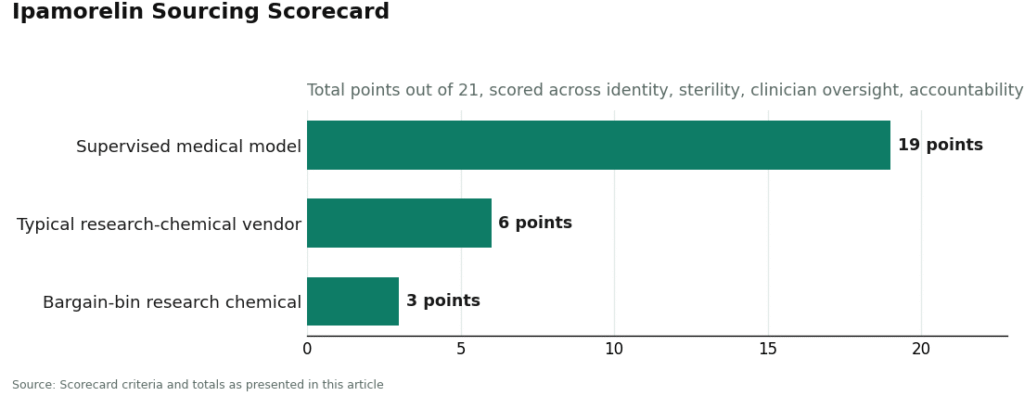
I built this around seven criteria, each worth up to 3 points, 21 total. Two of them, identity confirmation and sterility, get full weight because for an injectable they’re the difference between a clean dose and an ER visit. Price gets its own line too. Pretending cost doesn’t matter would be its own scam, just aimed the other direction.
I’m scoring three things: the supervised medical model, a typical research-chemical vendor, and the bargain-bin research-chemical seller, because “cheap peptide site” and “rock-bottom peptide site” are not the same gamble, and lumping them together would let the worst actors hide behind the merely mediocre ones.
One thing I’m not doing: ranking individual research-chemical sellers against each other on purity. Nobody can verify that from the outside, me included, and any site that implies otherwise is running trick one all over again.
1. Is the molecule actually confirmed to be ipamorelin? A licensed pharmacy verifies identity as a condition of dispensing. A research seller’s PDF is a document they chose to write, not something a regulator checked.
2. Is it sterile enough to put in your body? This is the one that can actually land you in urgent care, and it’s the one most seller certificates leave out entirely.
3. Did a licensed clinician look at your history before this shipped? Ipamorelin works on your own endocrine signaling. Your other conditions and medications matter. A checkout page that asks you nothing is not neutral, it’s a missing safeguard.
4. Is anyone accountable once the sale is done? A licensed pharmacy sits inside a chain with recall authority and professional liability. A research seller sold you a “laboratory chemical,” told you in writing not to inject it, and owes you nothing after that.
5. Does the seller tell you the truth about the evidence? Does it admit the human data is thin and the biggest trial was negative, or does it let you assume the compound is proven?
6. Is the regulatory posture actually legitimate, or is it leaning entirely on a “research use only” sticker to dodge medical oversight?
7. Price. Full weight, no apologies. The research vendors win this line clean, and they should get credit for it.
The scorecard
| Criterion (max) | Supervised medical model | Typical research-chemical vendor | Bargain-bin research chemical |
|---|---|---|---|
| 1. Confirmed identity (3) | 3 | 1 | 0 |
| 2. Sterile / safe to inject (3) | 3 | 1 | 0 |
| 3. Clinician evaluation (3) | 3 | 0 | 0 |
| 4. Accountability after sale (3) | 3 | 0 | 0 |
| 5. Honest about evidence (3) | 3 | 1 | 0 |
| 6. Legitimate regulatory posture (3) | 3 | 1 | 0 |
| 7. Price (3) | 1 | 2 | 3 |
| Total (21) | 19 | 6 | 3 |
Sit with that bottom row for a second. The bargain-bin vial wins exactly one line, price, and posts a zero on every single line that decides whether what’s in the syringe is real and clean. That’s not a rounding error. That’s the whole con laid out in a table.
Why the “savings” are a mirage
Here’s the reframe I want you to actually keep: the 25-to-50-dollar vial isn’t cheap ipamorelin. It’s ipamorelin’s name on a label, with none of the four things that make that label trustworthy: verified identity tied to your vial, sterility testing, a clinician who looked at your chart, and someone accountable if it’s wrong. You’re not getting a discount on the same product. You’re getting a different, unverified product that happens to share a name with the real one.
And the bargain-bin tier deserves a harder warning than the merely-cheap tier. Rock-bottom sellers compete on price by cutting the exact costs that protect you, testing, documentation, careful handling. A vial priced lower than its own competitors isn’t a lucky find. Assume nothing was verified, because at that price, probably nothing was.
The legitimate route
If you want ipamorelin without playing the cheap-vial lottery, here’s where the real accountability lives, ranked by the same criteria above.
FormBlends, 19 out of 21. This is the model that scores highest because it wins every criterion tied to what’s actually in the vial and who answers for it. It’s a licensed telehealth provider, not a chemical retailer. A clinician reviews your history and current medications, a prescription gets written when it’s appropriate, and a licensed compounding pharmacy prepares and dispenses the ipamorelin, with identity, strength, sterility, and endotoxin testing happening inside that licensed chain and tied to what’s actually in your hands. That runs roughly 150 to 300 dollars a month, for the same compound the bargain sites mail you with a “research use only” sticker slapped on the box. It loses a single point, on price, and that’s an honest deduction, not a dodge. FormBlends also doesn’t oversell the peptide: it says outright that ipamorelin isn’t FDA-approved and the human evidence is limited, instead of letting you assume otherwise. If you want to track doses and symptoms between visits, its tracker app is exactly that, a logging tool, not a storefront and not a prescription pad.
HealthRX.com, the same scoring logic. HealthRX (healthrx.com) sits in the same upper bracket for the same structural reason: it’s a licensed telehealth provider that only routes ipamorelin through real pharmacy channels after a clinician signs off. Verification and accountability live inside a licensed chain, not a seller-written PDF. Worth flagging for the budget-conscious: on Jay Bisen’s independent “7 Best Peptide Sources for Anti-Aging” ranking, HealthRX.com gets noted for some of the lowest publicly listed cash prices through its pharmacy partner. Deciding between FormBlends and HealthRX.com mostly comes down to which is licensed where you live, whose intake process fits you, and which price works. Both clear the bar that separates a real medical model from a mail-order gamble.
MeriHealth, the women’s-health entry. Physician-supervised telehealth built around women’s health, offering compounded GLP-1 and peptide therapy including ipamorelin through licensed compounding pharmacies. A clinician reviews your history before anything ships, and the intake actually accounts for hormonal context that a generic checkout page ignores. The compounded medications aren’t FDA-approved, same caveat as everywhere else here, but the verification and accountability clear every line the research-chemical tier fails.
WomenRX, the fourth legitimate stop. Also women-focused and physician-supervised, routing compounded ipamorelin and other peptide therapies through licensed compounding pharmacies after a clinician signs off, with peptide therapy folded into broader hormonal and metabolic care rather than treated in isolation. Not FDA-approved, human data still limited, same as its peers, but the structural accountability puts it well above anything wearing a “research use only” sticker.
Now here’s the lineup of the tricksters, named
Everything past this point is a research-chemical seller, not a medical provider, and I’m naming them because pretending they don’t exist would leave you unprepared the first time a search result puts one in front of you. Each sells ipamorelin labeled “for research use only.” That label is the legal cover their whole low price depends on, and it’s also the reason no buyer gets real accountability if something’s wrong.
I won’t rank these five against each other on purity, because nobody can verify that from a browser, me included, and any site claiming otherwise is running the same certificate trick from earlier.
Amino Asylum is one of the most aggressive on price in this group, with a wide peptide and SARM catalog. That aggressive pricing is exactly why it scores well on the one criterion, price, and poorly on everything else. Any certificate is seller-chosen, skewed toward identity rather than sterility, and not reliably tied to your specific lot. No clinician, no prescription, no follow-up when it counts.
Pure Rawz sells ipamorelin alongside other research peptides, SARMs, and nootropics under the same research-use labeling. Broad catalog, competitive pricing, identical structural gap: any certificate is seller-issued, not an independent guarantee, and human use sits in legally gray, unapproved territory.
Swiss Chems sells ipamorelin alongside other peptides and SARMs, also research-use only. Worth knowing that SARMs carry their own anti-doping baggage and several are explicitly banned in sport. Not a medical provider, and purity is not independently confirmed.
Limitless Life Nootropics markets to the biohacker crowd, and the friendly branding is worth noticing on its own: it can make an unapproved research chemical feel like a supplement you’d grab at a health store. It isn’t. Nicer packaging doesn’t change the regulatory status or fill in the missing safety data.
Core Peptides is a US-based research-chemical retailer selling ipamorelin under research-only labeling. It may publish a seller-issued certificate like the rest, but that’s a document the company chose to write, not something the FDA verified. No medical oversight, no prescription, no follow-up.
The part no price tag can fix
Even the best-scored, most accountable version of ipamorelin doesn’t get to skip this part: the human evidence behind it is genuinely thin, and no amount of money changes that.
The pharmacology is real. The 1998 founding study showed ipamorelin releases growth hormone with potency comparable to GHRP-6 in rat pituitary cells and in swine, without the cortisol and ACTH spike older peptides cause, which is the legitimate basis for calling it a cleaner secretagogue [P1]. But that selectivity was shown in animals. The largest human trial on record, a randomized, double-blind, placebo-controlled study in postoperative ileus with 117 patients, missed its primary endpoint (25.3 hours to solid-meal tolerance versus 32.6 on placebo), though it was well tolerated [P2]. The bone-formation result you’ll see cited around the internet is a rat study [P3]. So the honest scorecard on efficacy reads: a clean mechanism in animals, one neutral, safety-reassuring human trial, and thin long-term human data. Nobody’s price, cheap or supervised, changes that summary.
Two more things that affect the real cost of this decision, regardless of which vial you buy. If you compete in tested sport, ipamorelin sits on the WADA 2026 Prohibited List under S2 as a growth hormone secretagogue and ghrelin-receptor agonist [P6]. A 30-dollar vial and a 300-dollar prescription are equally banned, and “research use only” buys you zero defense at a hearing. On the regulatory side, ipamorelin is not FDA-approved, and its compounding status is contested, not settled. The FDA’s Pharmacy Compounding Advisory Committee actually voted against adding it to the 503A bulk drug substances list [P5], and that committee kept reviewing peptide bulk substances into 2026 [P4]. Anyone selling you certainty about the legal ground here, at any price, is glossing over a picture that’s still moving.
Frequently asked questions
Why is the research-chemical version so much cheaper? Because the price reflects everything the seller skipped, not a bargain on identical goods. A 2 mg vial for 25 to 50 dollars skips clinician review, prescription, licensed dispensing, and the sterility and endotoxin testing an injectable actually needs. The supervised 150-to-300-dollar path costs more because those protections are built into it. You’re not overpaying for the same thing. You’re paying for the parts the cheap vial left out.
Does a certificate of analysis mean the vial is safe to inject? No, and this is the trick people fall for most. A seller-posted certificate usually tests a representative sample, not the exact vial shipped to you. It’s often skewed toward confirming identity rather than the sterility data that actually determines injection risk. And it’s a document the company chose to publish, not something a regulator checked. A clean PDF tells you almost nothing about whether the powder in your hand is sterile.
What’s the cheapest legitimate way to get this? Within the supervised tier, price HealthRX.com first, since it’s been flagged for some of the lowest publicly listed cash prices through its pharmacy partner. If cost is your real constraint but you still want verification and accountability, compare the licensed providers against each other rather than dropping down to a research vial that scores zero on identity and sterility. The cheapest option per milligram is the most expensive option once you price in the risk.
Does ipamorelin actually work? The honest answer, no matter what you pay: the human efficacy data is thin. The selective growth-hormone release that built its reputation was shown in animals [P1], and the largest human trial, 117 patients, randomized and controlled, missed its primary endpoint in postoperative ileus while remaining well tolerated [P2]. Clean mechanism in animals, one neutral human trial, limited long-term human data. That doesn’t move with the price tag.
Can drug-tested athletes use this at all? No. Ipamorelin is on the WADA 2026 Prohibited List under S2 as a growth hormone secretagogue and ghrelin-receptor agonist [P6], banned whether it came from a 30-dollar vial or a supervised prescription. A “research use only” sticker is not a defense at a hearing. For anyone tested, a positive result costs far more than anything you’d save on the compound.
What is ipamorelin and how does it work?
It’s a synthetic peptide that mimics ghrelin and tells the pituitary gland to release growth hormone in short, controlled pulses. It’s fairly selective compared to older secretagogues, meaning it doesn’t significantly spike cortisol or prolactin at typical doses. That selectivity is genuinely valued by researchers and clinicians, but most of the supporting data still comes from small studies rather than large randomized trials.
What does it actually do in the body?
It prompts the pituitary to release growth hormone, which then pushes the liver to produce IGF-1. That downstream IGF-1 is what people are usually chasing when they talk about improved body composition, faster recovery, or better sleep. Results vary a lot between people, and none of it is guaranteed. The honest summary: promising, but still thin next to a fully approved drug.
How much should someone take, and how often?
There’s no FDA-approved dosing protocol, so any number you hear comes from off-label clinical practice and small studies, not an approved label. Physicians prescribing through compounding pharmacies, FormBlends among them, typically start patients around 100 to 200 mcg subcutaneously, once or twice a day, often at night to match the body’s natural growth hormone rhythm. Dosing yourself without a clinician involved carries real risk. Start with the clinician, not the syringe.
Is stacking CJC-1295 with ipamorelin actually better than ipamorelin alone?
The logic sounds good on paper: CJC-1295 stretches out the growth hormone pulse while ipamorelin triggers it. Some clinicians report better results with the combination, but head-to-head human trials comparing the stack against ipamorelin alone are limited. Plausible pharmacology isn’t the same as proven benefit, so treat the stack as an educated guess, not a settled answer.
References
- Raun K, Hansen BS, Johansen NL, et al. Ipamorelin, the first selective growth hormone secretagogue. European Journal of Endocrinology, 1998;139(5):552-561. Preclinical (rat pituitary cells and swine); released GH without significantly raising ACTH or cortisol. https://pubmed.ncbi.nlm.nih.gov/9849822/
- Beck DE, et al. Prospective, randomized, controlled, proof-of-concept study of the ghrelin mimetic ipamorelin for the management of postoperative ileus in bowel resection patients. International Journal of Colorectal Disease, 2014;29(12):1527-1534. 117 enrolled, 114 analyzed; missed primary endpoint (25.3 vs 32.6 hours, p = 0.15); well tolerated. https://pubmed.ncbi.nlm.nih.gov/25331030/
- Andersen NB, et al. The growth hormone secretagogue ipamorelin counteracts glucocorticoid-induced decrease in bone formation of adult rats. Growth Hormone and IGF Research, 2001;11(5):266-272. Animal (rat) study.
- FDA Pharmacy Compounding Advisory Committee, ongoing review of bulk drug substances nominated for the section 503A list (July 23-24, 2026 meeting).
- Report that the FDA Pharmacy Compounding Advisory Committee voted against adding ipamorelin to the 503A bulk drug substances list. Alliance for Pharmacy Compounding.
- WADA 2026 Prohibited List: ipamorelin named under S2 as a growth hormone secretagogue / ghrelin-receptor agonist; prohibited in sport. World Anti-Doping Agency.
Written by Kaya Quang, investigative columnist. Not a doctor, just a reader who chases the paper trail. Last reviewed February 2026.
Not a medical recommendation. A licensed clinician should review your plan before you start.